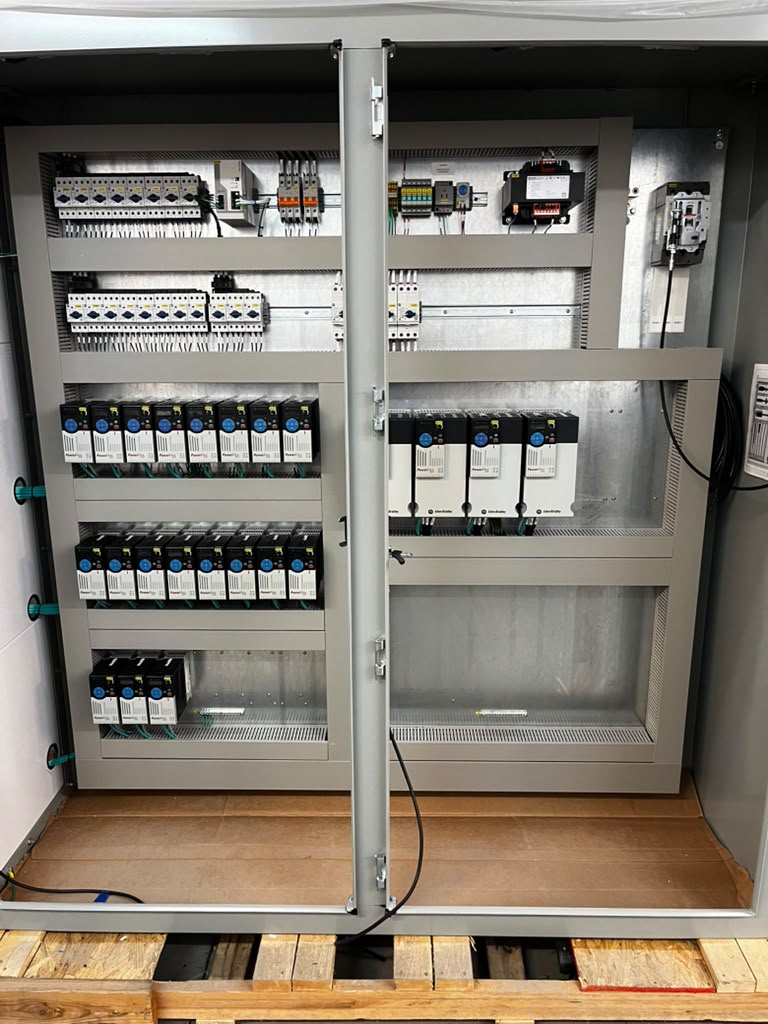
Panels built to be opened at 3 a.m.
Anyone can fit components into an enclosure. We build industrial control panels that a maintenance tech who has never seen the job can open under pressure, read, and put back in service. That is the moment a panel is actually judged, and it is the moment we build for.
One crew draws it, builds it, installs it, and answers the phone two years later.
Most plants end up with a panel builder in one state, an installing contractor in another, and an integrator who wrote the program and moved on. Then something trips at shift change and nobody owns it. Every party has a reason it is not their scope, and your line stays down while that gets sorted out.
Mosaix is an industrial electrical contractor that draws the panel, builds it in our Burley shop, installs it in your plant, commissions it, and keeps your drawings on file. One number to call. Nobody to referee.
Control panel fabrication, plant electrical, and the support that comes after.
The work below is what plant engineers and maintenance managers call us for most. All of it comes out of the same shop and the same crews, which is why the handoffs do not drop anything.
Control Panel Fabrication
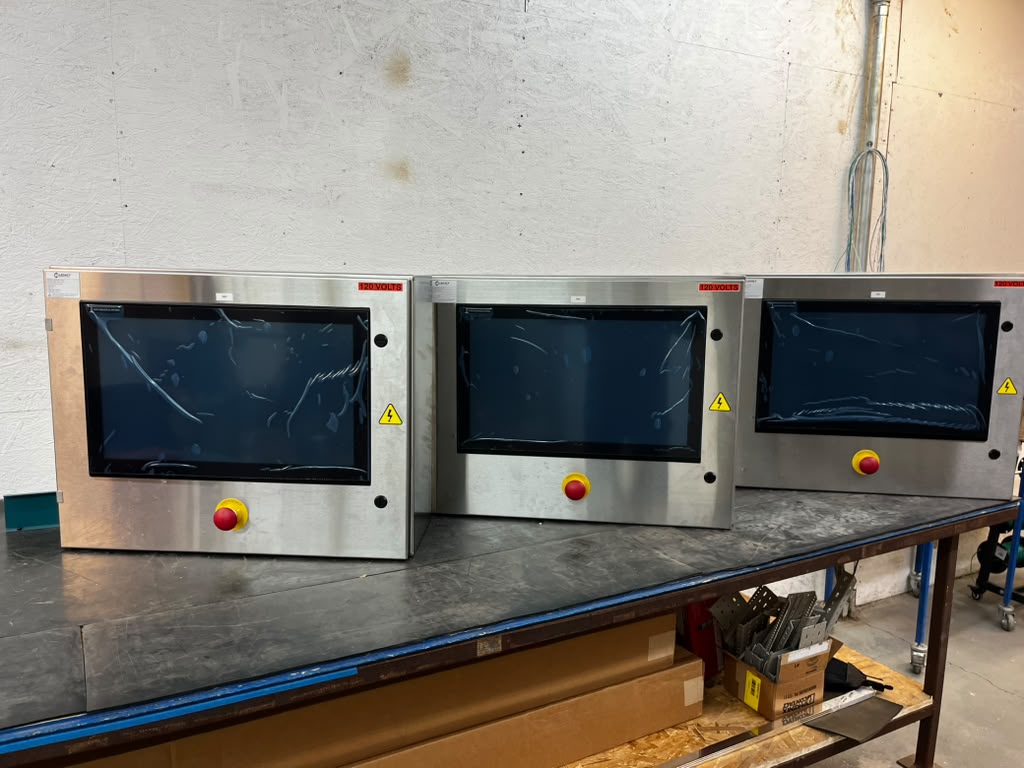
Motor control centers, VFD panels, PLC and I/O cabinets, HMI stations, pump and conveyor controls — drawn, built, wired, and function-tested on the bench before they ship.
- Motor control & VFD panels
- PLC and remote I/O cabinets
- Operator stations and HMI enclosures
Plant Electrical Installation
Feeders, branch circuits, conduit and cable tray, motor terminations, disconnects, instrumentation, and equipment hookups — including tie-ins inside a live plant on a window that does not move.
- Equipment power and hookup
- Conduit, tray, and terminations
- Shutdown and tie-in work
VFD, PLC & HMI Integration
Drive setup and tuning, I/O checkout, loop verification, HMI screens, and getting new equipment to talk to the line it was dropped into. Allen-Bradley by default, but we work on what you already own.
- Drive parameterization and tuning
- I/O point checkout and loop checks
- Operator screen work
Stainless & Washdown Panels
304 and 316 stainless enclosures built for sanitation: sloped tops, sealed penetrations, hygienic cord grips, and gasketing chosen for the chemicals your plant actually runs.
- Food-grade and dairy environments
- Sanitary-design mounting details
- Sealed-enclosure thermal management
Troubleshooting & Downtime Response
Nuisance trips, intermittent faults, ground faults that only show on second shift, drives that fault under load, and the panel nobody has a drawing for. This is the work we are best at.
- 24/7 emergency field response
- Fault-finding, not parts-swapping
- Drive and motor circuit diagnosis
Documentation & Retrofit
Tracing out undocumented panels, rebuilding drawing sets to match what is actually installed, and modernizing legacy starters and controls without replacing an entire line.
- As-built drawing recovery
- Legacy control upgrades
- Spare-parts standardization
Two panels can cost the same and behave nothing alike.
The gap does not show up at quote time. It shows up the first time somebody has to open the box with the line down.
What a cheap panel costs you later
- No assembly short-circuit rating on the nameplate, so nobody knows what it is rated for
- Wire numbered at one end, or not at all, and no two conductors the same color for a reason
- Duct packed to the lid — adding one circuit means pulling the panel apart
- Drawings that stopped matching the panel during startup three years ago
- Drives crammed together, running hot, failing in rotation every summer
- Whoever built it is four states away and does not answer after five
What the same money buys here
- Your electrician answers the inspector's rating question without opening a cover
- A fault gets traced in minutes by somebody who has never seen the panel before
- Next year's line addition is an afternoon, not a panel rebuild
- The drawing in the door pocket is the panel you actually own
- Drives that run cool enough to still be in service in year eight
- One number, answered, with your schematic already open on our end
Five things worth specifying before you buy a panel.
A panel looks finished the day it ships. Whether it was built right shows up three summers later, during the hottest week of the season, on the line you cannot stop. We build to your specification rather than to a template — you are paying for the panel, so it gets built the way your plant needs it. These are the five details that make the most difference, and what each one actually means. Tell us which matter on your job.
Short-circuit current rating, calculated and marked
A cabinet full of good components is not a rated assembly. SCCR is set by the weakest device in the fault path, and one unrated component can drag an otherwise solid panel down. We work the assembly rating, select components to hold it, and put the real number on the nameplate — so your plant electrician is not guessing during an inspection or an insurance walk-through.
Heat load figured before the layout is drawn
A VFD puts roughly two to three percent of its rated power into the enclosure as heat. Stack several large drives into a sealed enclosure in a room that runs 95 °F and you have built a drive-failure machine. We calculate enclosure heat load against real ambient conditions, spec filtered fans, closed-loop coolers, or vortex cooling accordingly, and leave the drives the clearance the manufacturer requires rather than the clearance that fits.
Wire you can trace without a drawing in your hand
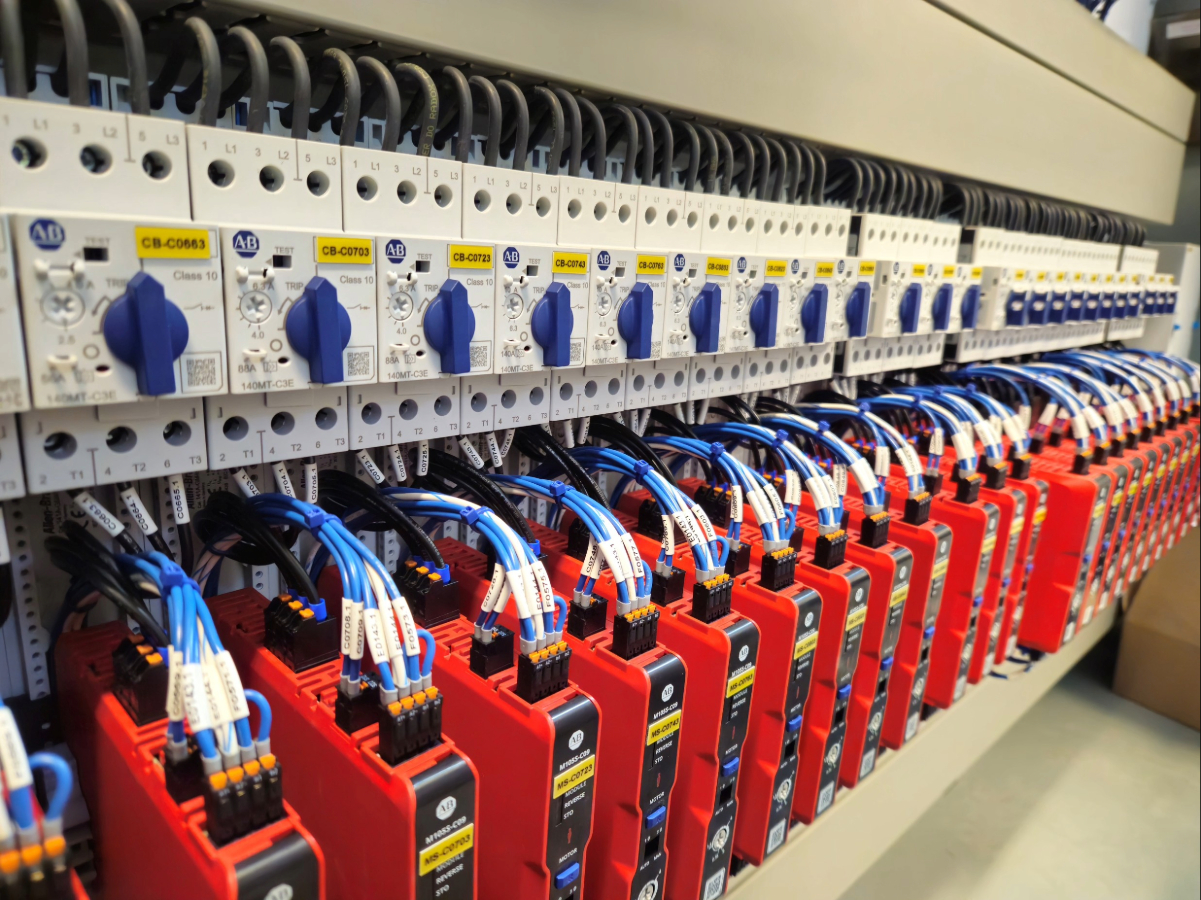
Every conductor numbered at both ends. Ferrules on stranded terminations. Wire duct filled to roughly sixty percent, not packed, so the next person can add a circuit without rebuilding the panel. Power and control separated. Shielded VFD cable grounded correctly at one end so it does not turn into a noise injector.
Drawings that match the panel that shipped
Panels get changed on the floor during startup. If those redlines never make it back into the drawing set, the documentation is worse than useless — it actively sends the next troubleshooter down the wrong path Our as-builts get corrected after commissioning, and you get the files, not just a paper set curling in the door pocket.
Safety circuits engineered, not improvised
E-stop strings, guard interlocks, and safety relays laid out so the machine stops the way NFPA 79 expects, and so the circuit is not trivially defeated by somebody under schedule pressure. Arc flash labeling and working clearance considered at layout, not discovered at inspection. If you have specific insurer or corporate engineering requirements, raise them before the drawings are approved — that is by far the cheapest point in a project to get it right.
From one-line to functional test.
None of these steps are unusual. The difference is that every one of them actually happens, in order, before the panel goes on a truck.
Design & drawings
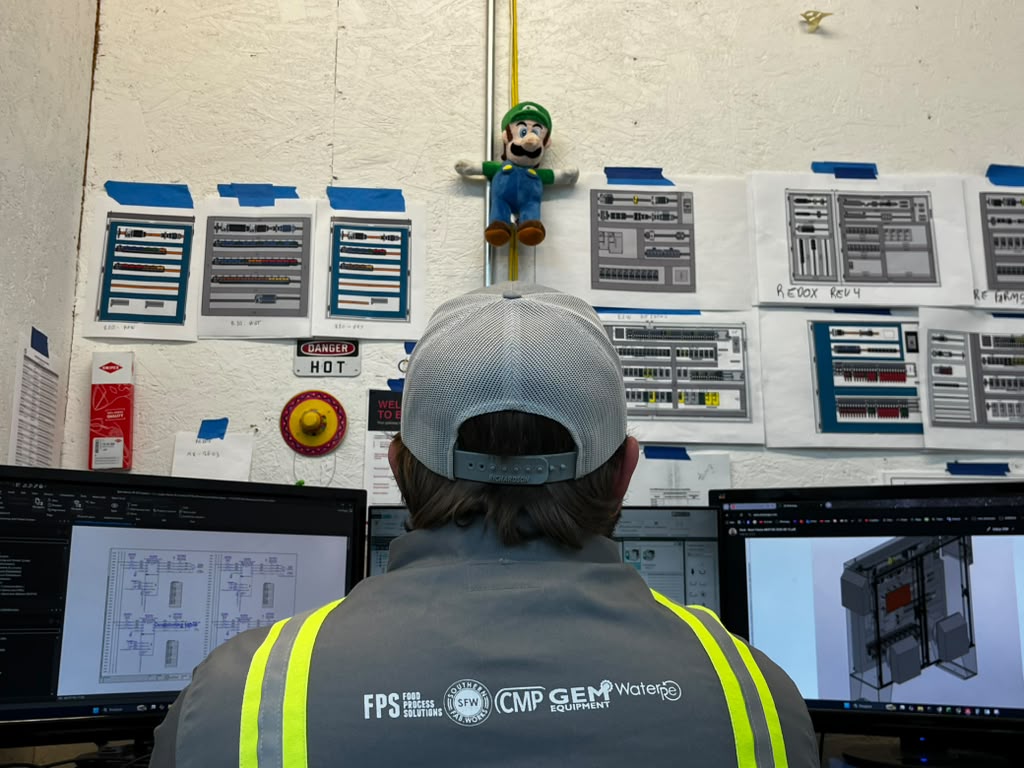
One-line, schematics, panel layout, I/O list, and bill of materials — drawn first. You review and approve the drawing set, not a finished panel you can no longer change without paying for it twice.
Component selection
Motor protection, branch protection, contactors, and drives sized to the actual load and duty cycle — and chosen so your maintenance crew can source a replacement locally instead of waiting three weeks on an import.
Shop build
Subplate laid out and drilled, components mounted, duct run, and every conductor pulled, numbered, ferruled, and landed — in a controlled shop, not on a plant floor with production running twenty feet away.
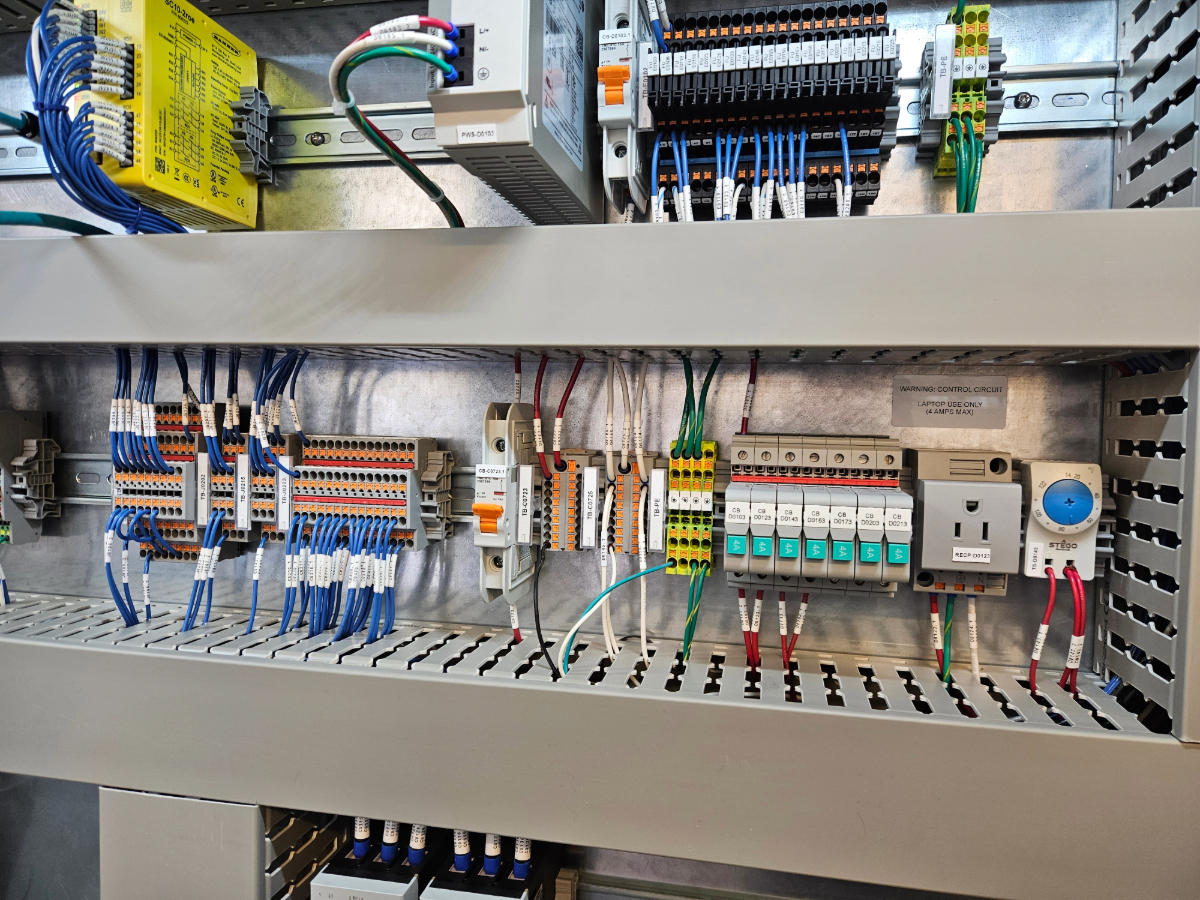
Controls & I/O
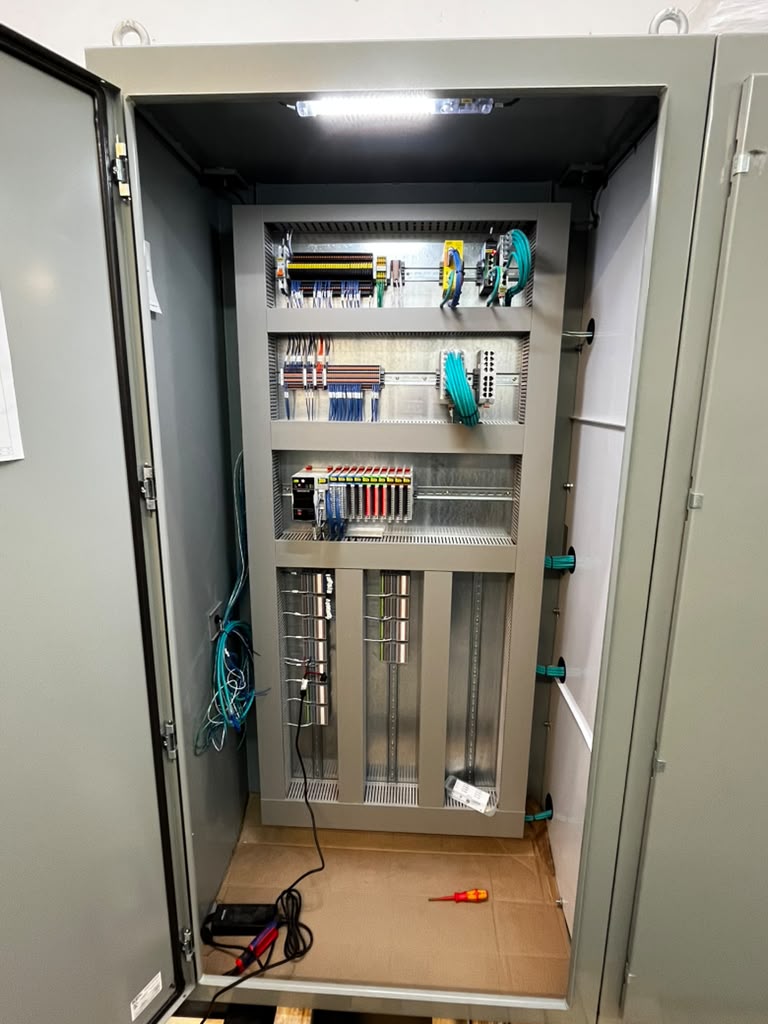
Processor, I/O, networking, and HMI installed and addressed. Every point checked against the I/O list so that field commissioning is about your process, not about hunting for a swapped pair.
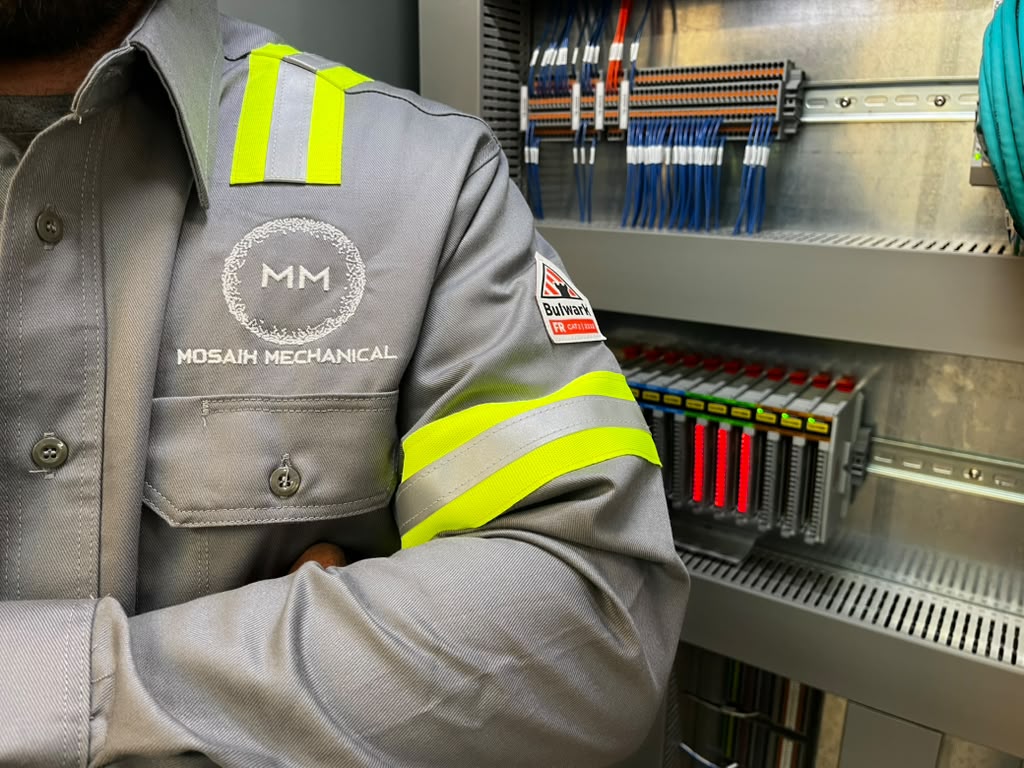
Tested before it ships
Point-to-point continuity, insulation resistance, control power energized, safety circuit proved, drives parameterized, and the sequence run on the bench. A fault found in our shop costs us an afternoon. The same fault in your plant costs you a shift.
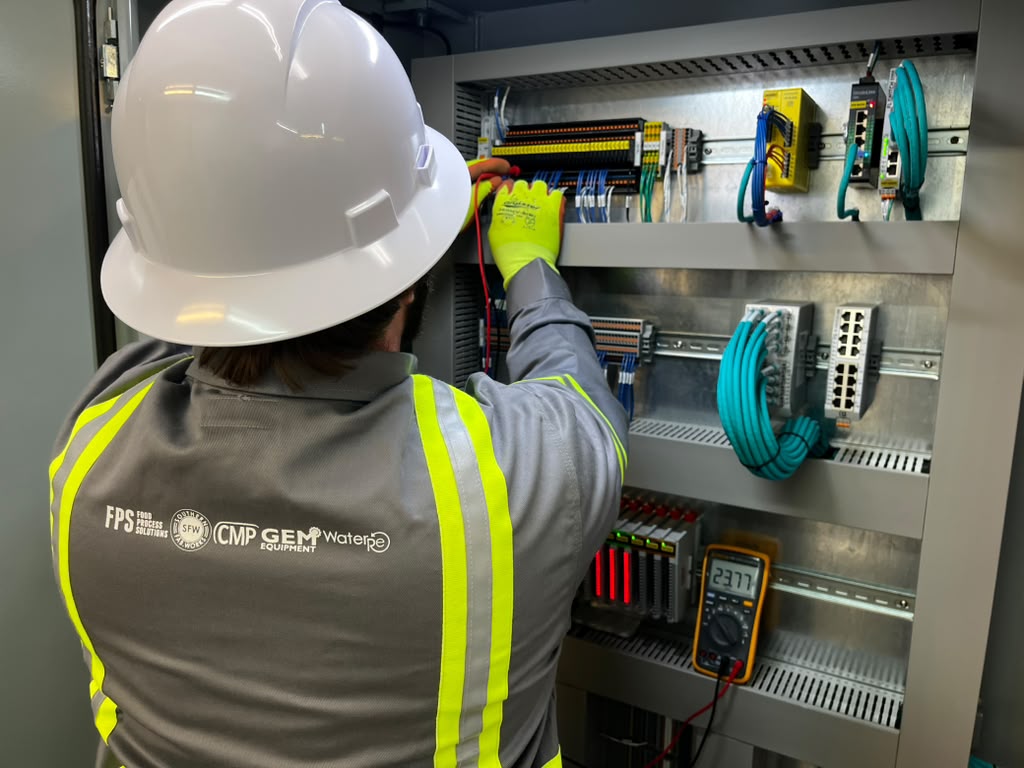
Install & commission
Set, landed, insulation-tested, rotation verified, loops checked, drives tuned under real load, and operators walked through the screens before we pull off site. Redlines go back into the drawings the same week, not the same quarter.
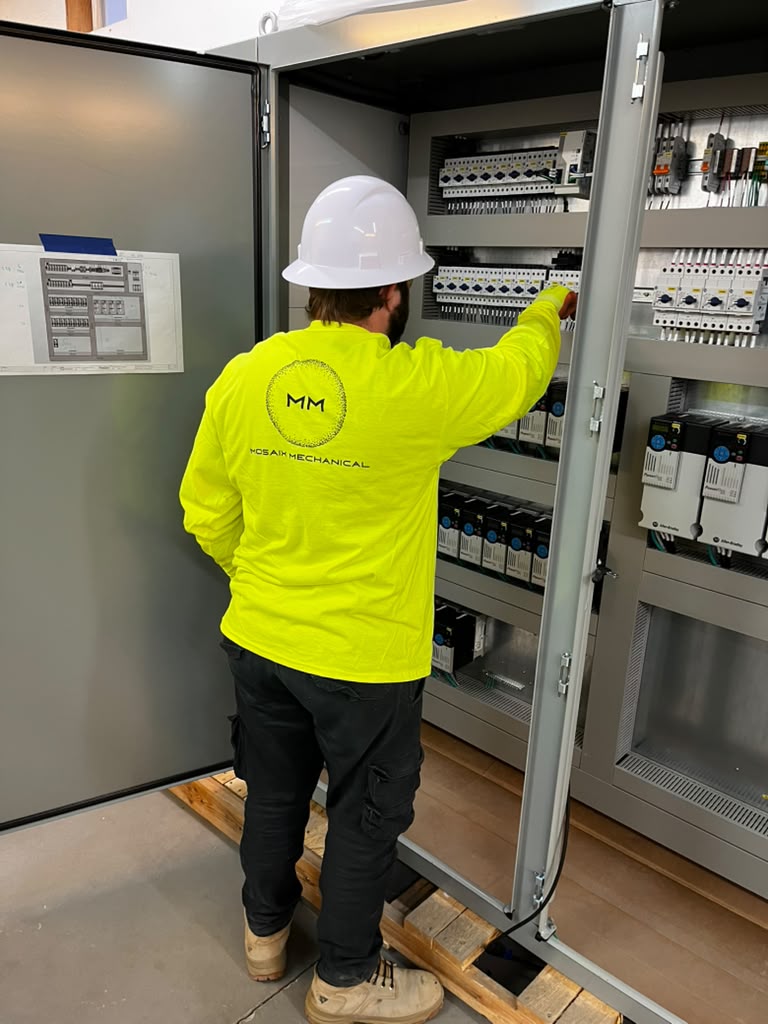
Panels that survive caustic, hot water, and a pressure washer aimed the wrong way.
In a dry plant, a painted steel enclosure lasts decades. In a dairy or a potato line it starts weeping rust at the seams inside a year, and the first sign of real trouble is a ground fault nobody can locate. Washdown is its own engineering problem, and we design for it on purpose rather than solve it with a better gasket after the fact.
- 304 & 316 stainless
- Sloped tops, no standing water
- Sealed penetrations
- Hygienic cord grips
- Stand-off mounting
- Gasketing matched to chemistry
- Closed-loop cooling
- Vortex cooling
Building a good panel takes skill. Still having your drawings open when you call eighteen months later is what actually keeps a plant running.
The panel is the easy part.
Plenty of shops can build a decent panel once. What separates a supplier from a contractor you keep is the call you make eighteen months later, when something is faulting intermittently and the line is running at half rate. Every panel we build or touch stays on file in Burley, so when you call we are reading the same schematic you are.
Troubleshooting is a discipline, not a parts swap
Intermittent faults, drives that only trip under load, ground faults that seem to move, and control circuits modified by three different people over ten years. We chase the cause instead of replacing components until the symptom relocates.
Spares that are worth the shelf space
After commissioning we tell you the three or four parts worth stocking and the ones that are not. Standardizing components across your panels is the cheapest reliability improvement most plants never get around to making.
We work around production
Tie-ins during your shutdown window, nights and weekends when that is when the line is cold, and lockout/tagout done properly every time — including the times it is inconvenient for us.
Line down right now?
Call and describe what is happening — what tripped, what the drive is reporting, what changed before it started. We can often narrow it down on the phone before a truck is on the road.
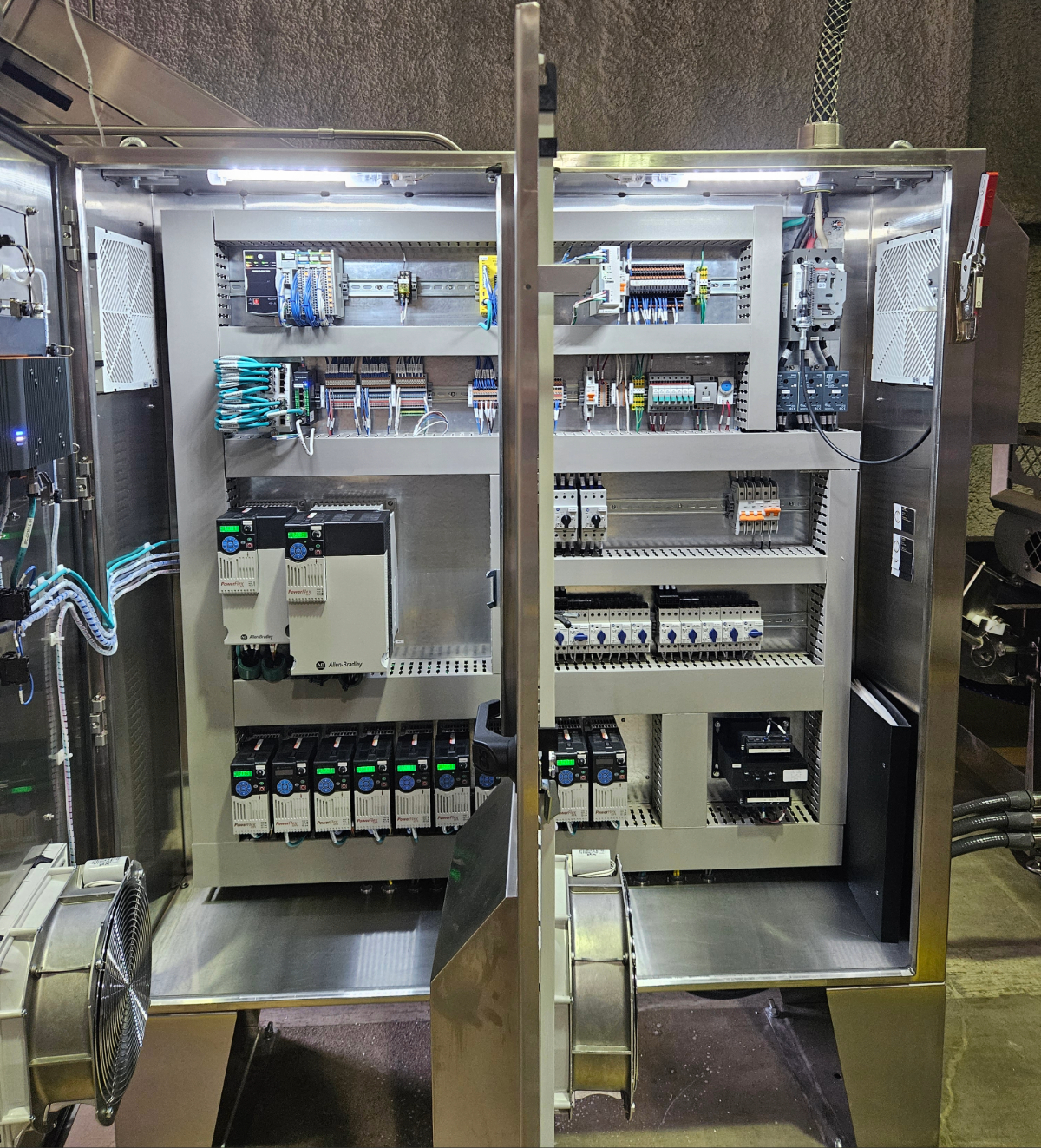
What our panels look like on the inside.
The outside of a control panel tells you nothing at all. Here is the part that matters — tap any photo to open it full size.
Based in Burley. Built for the Magic Valley, and willing to travel.
Our shop sits in Burley, Idaho, which puts us inside an hour of one of the densest concentrations of food processing and dairy plants in the country. For panel builds, planned installs, and shutdown support we travel well past that — the panel gets built here either way.
- Burley, ID
- Rupert & Heyburn, ID
- Paul & Declo, ID
- Twin Falls, ID
- Jerome, ID
- Hazelton & Eden, ID
- Magic Valley
- Mini-Cassia
- Western United States
- Nationwide panel builds
What plant engineers ask us first.
Can you do electrical work while our plant is running?
Yes. Most of what we do happens in an operating facility. New panels are built and tested in our Burley shop so the in-plant work is reduced to setting, terminating, and commissioning — which is exactly what lets a tie-in fit inside a short shutdown window. When work has to happen live, it happens under a lockout/tagout plan agreed with your maintenance and safety leads before anyone opens a cover.
Do you do PLC programming, or only the wiring?
We handle drive configuration and tuning, I/O checkout, loop verification, HMI screen work, and modifications to existing logic. Allen-Bradley is our default platform. For ground-up process control development on a large system, we will tell you plainly when an OEM or a dedicated integrator is the better fit, and then build and install to their design. We would rather scope it honestly than learn your process on your dime.
What if we do not have drawings for our existing panel?
Common, and not a problem. We trace the panel out, document what is actually in there — including the modifications nobody wrote down — and hand you a drawing set that matches reality. Plants often find that this alone cuts their next troubleshooting call from a full shift to about an hour.
Can you build panels for washdown and food-grade areas?
Yes, and it is a large share of what we build. Stainless enclosures in 304 or 316 depending on your sanitation chemistry, sloped tops, sealed penetrations, hygienic cord grips, and stand-off mounting so the area behind the panel can actually be cleaned. Sealed enclosures in hot rooms get closed-loop or vortex cooling sized against a calculated heat load.
Can you build a panel to our existing plant standard?
Yes, and we prefer it. If your site standardizes on particular breakers, drives, terminal blocks, wire colors, or labeling conventions, send us the standard and we will build to it. Consistency across your panels is worth more to your maintenance crew than any preference we have.
How far out are you on panel builds?
Lead time is usually driven by component availability rather than shop capacity — certain drives and breakers still carry long lead times. We quote a real date based on current procurement, and if a single component is going to drive the schedule we say so up front and offer alternates rather than letting the date slip quietly.
What standards do you build to?
Panels are built to NFPA 79 and the NEC, with assembly short-circuit current ratings worked out and marked, and arc flash and working clearance considered at the layout stage rather than at inspection. If you have specific inspection, insurer, or corporate engineering requirements, raise them before the drawings are approved — that is by far the cheapest point in a project to get it right.
Electrical is usually one part of a bigger job.
Send us the problem, not a spec sheet.
Tell us what the equipment has to do, what your plant already runs on, the environment it lives in, and when it has to be in service. We will tell you what it takes — and if we are not the right shop for the job, we will say so rather than find out together.
Burley Shop
Where the panels get built, wired, and bench-tested.
238 W 35 SBurley, ID 83318